


Have you ever woken up with that strange, familiar feeling—not again—because you just had the same dream again and again?
Same place. Same situation. Same emotional punch.
You’re not alone. Recurring dreams are one of the most common (and most confusing) dream experiences people have. They can feel unsettling, comforting, or just plain exhausting—especially when you don’t know why they keep happening.
This article is here to help you make sense of that repetition. Not as a prophecy. Not as a hidden message from the universe. But as something deeply human: a signal from your own mind, shaped by emotion, memory, and stress.
What Recurring Dreams Commonly Feel Like
People describe recurring dreams in surprisingly similar ways, even when the details are different.
You might notice:
- A strong sense of déjà vu while dreaming
- The feeling that you know what’s about to happen next
- Waking up thinking, “I’ve had this before… haven’t I?”
Emotionally, repeated dreams often come with:
- Fear or anxiety – especially if the dream involves danger, being chased, or losing control
- Confusion – because the dream feels important, but unclear
- Frustration – wondering why your brain won’t move on
- Curiosity – a quiet sense that the dream is trying to tell you something
For many people, it’s not even the events of the dream that stand out—it’s the feeling. The emotional tone stays with you long after waking.
If you’ve ever thought, “Why am I having the same dream again?”—that question itself is part of the experience.
The Psychology Behind Recurring Dreams
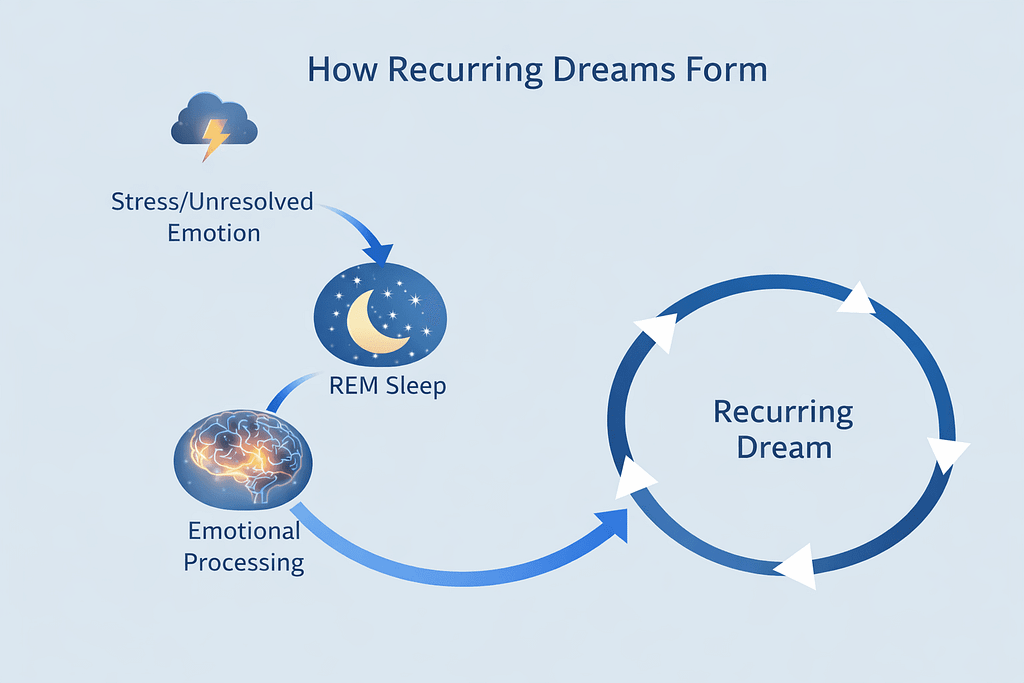
From a psychological and neuroscience perspective, recurring dreams are not random. They’re often linked to how the brain processes emotions and unresolved experiences.
Here are a few key ideas that explain why the same dream may return.
Emotional Processing
Dreams are one way the brain works through emotions that didn’t get fully processed during the day.
If a certain feeling—fear, guilt, sadness, pressure—doesn’t get resolved, the mind may revisit it during sleep.
That’s why recurring dreams are often tied to emotional themes rather than specific events.
Stress and Anxiety
Periods of ongoing stress can increase dream repetition. When your nervous system stays on high alert, your dreams may replay similar scenarios as a way of coping or rehearsing.
This doesn’t mean something is “wrong” with you—it means your brain is trying to manage load.
Memory Consolidation
During REM sleep, the brain strengthens and reorganizes memories. If certain memories or emotional patterns are especially strong, they may reappear in dreams—sometimes in symbolic or repetitive ways.
Why It Repeats
The key thing to understand:
Recurring dreams don’t repeat because they’re important in a universal way. They repeat because they’re unresolved in a personal way.
What matters isn’t what the dream is, but what it connects to in your waking life.
A Realistic Dream Example
“I had this same dream again. I’m back in my old school, walking through empty hallways. I’m not scared, but I feel uneasy. Why am I having it again?”
There’s no single “correct” interpretation here—but there are thoughtful possibilities.
- Schools often represent learning, evaluation, or pressure
- Empty hallways might reflect uncertainty or transition
- The uneasy feeling could point to something unresolved—not fear, but discomfort
Rather than asking “What does this dream mean?”, a more helpful question might be:
Where in my life do I feel like I’m back in an old pattern—or being tested again?
Recurring dreams often connect emotional states from the past to present-day situations, even if the surface imagery feels outdated.
Common Variations of Recurring Dreams
If the Dream Repeats Very Often
When a dream happens frequently—weekly or even nightly—it may reflect ongoing emotional stress or a situation that hasn’t changed yet.
The mind keeps returning because it hasn’t found resolution.
If the Dream Feels Extremely Vivid
Vivid recurring dreams are often tied to strong emotional charge. Your brain marks the experience as “important,” making it easier to remember and replay.
This doesn’t mean danger—it means intensity.
If It Happens During Stressful Periods
Many people notice the same dream again and again during major life changes:
new jobs, breakups, exams, burnout, uncertainty.
Once stress levels drop, the dream often fades or changes.
If the Dream Evolves Over Time
Sometimes the setting stays the same, but the outcome changes.
This can reflect emotional growth—your mind is updating how it relates to the underlying issue.
Small changes in recurring dreams are often meaningful.
How Dream Journaling Helps You Understand Recurring Dreams
One of the most effective ways to understand recurring dreams is also one of the simplest: writing them down.
Why Writing Helps
When you journal a dream immediately after waking:
- You strengthen recall
- You capture emotional details that fade quickly
- You create a record your waking mind can reflect on
Over time, patterns emerge—not just in what you dream, but in how you feel.
Pattern Recognition
Recurring dreams often share themes:
- Loss of control
- Being late or unprepared
- Searching for something
- Being observed or judged
Tracking these patterns helps shift the question from “Why this dream?” to “Why this feeling?”
The Science Behind It
Writing engages conscious awareness. When emotions move from the subconscious (dreams) to conscious reflection (journaling), they’re easier to process and integrate.
This is why journaling can reduce the emotional intensity of repeated dreams over time.
A Gentle Reflection Before You Go
Before you dismiss your recurring dream—or try to force an interpretation—pause and ask yourself:
- What was happening in my life when this dream first started?
- How does the dream make me feel, not just what happens in it?
- Has anything in my waking life stayed unresolved or repetitive too?
Sometimes, the dream isn’t asking for an answer.
It’s asking for attention.
And once you start listening, the repetition often softens on its own.
Understanding Recurring Dreams with DreamStory
When you experience recurring dreams, the biggest mistake most people make is trying to interpret them in isolation.
You wake up, search the meaning, read a general explanation — and that’s it.
But recurring dreams don’t live in one night.
They live in patterns.
And patterns only become visible over time.
That’s where DreamStory becomes genuinely helpful.
Instead of offering a one-time, generic meaning, DreamStory helps you:
- Journal your dreams immediately after waking
- Track repeated themes and emotional patterns
- Notice how the same dream shifts across weeks or months
- Connect dream emotions to real-life stress or change
Because recurring dreams aren’t just about symbols.
They’re about emotional repetition.
DreamStory vs. Googling Recurring Dreams
Here’s the key difference:
Googling “recurring dreams meaning” gives you a list of possible interpretations.
But it doesn’t know:
- When your dream started
- How often it repeats
- What was happening in your life at the time
- How the dream makes you feel
DreamStory looks at your dreams in context.
Instead of saying, “This symbol always means X,” it helps you explore:
- When the pattern began
- Whether stress levels were higher
- If the dream outcome is evolving
- Which emotions show up most often
That’s what turns repeated dreams into self-awareness.
Why Pattern Tracking Changes Everything
Recurring dreams are rarely about prediction.
They’re about emotional loops.
When you track dreams consistently, you may notice:
- The same dream returns during specific stressful periods
- The dream becomes less intense after resolving something
- The ending changes when your confidence increases
Those insights don’t come from a single search.
They come from reflection over time.
DreamStory combines dream journaling, pattern tracking, and AI-powered interpretation to help you see the bigger picture — not just the symbol of the night.
Dreams become clearer when you look at them across weeks, not just one morning.


